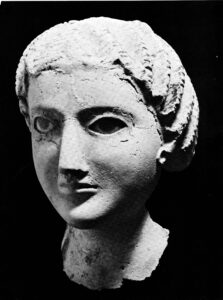
Eidolon, for soprano, mezzo-soprano, actor (countertenor), and mixed chamber ensemble, sets to music poetry from Helen in Egypt (1961) by Hilda Doolittle (aka H.D.), a semi-dramatic lyric narrative that revisits and rewrites the myth of Helen of Troy. I am drawn to H.D.’s late poem because of its relation to themes that interest me in my own work, namely multiple identity, mysticism, memory, dream states, and Greek drama. According to H.D. and Euripides in his play Helen, the Helen that went to Troy was an eidolon, a phantom or specter “conjured out of air” by the gods. H.D. takes this idea and runs with it in her own epic poem, which takes the form of a series of three-line choral stanzas interspersed with prose.
My new work deemphasizes traditional narrative in favor of new dramaturgies rooted in the psyche of the heroine, Helen. The structure of Eidolon springs out of the form of H.D.’s poem. It begins with Helen’s own “defense” or “pallinode”—a song to counter the negative portrayals of Helen in traditional texts. She is aware of how negatively she has been defined by the masculine world, which H.D. associates with death, war, chaos—Sigmund Freud’s “death drive.” The journey of Helen over the course of the work is one in which she ultimately transcends male definitions of womanhood by negating them through a commitment to life and love. At the end of the full chamber opera, she merges with the poem’s mother Goddess, Thetis, in an ecstatic final aria. This version of the chamber opera comprises the first two scenes, which may be performed as a standalone piece.
The other characters consist of Helen’s foil, the eidolon or “fake” Helen (of Troy), who represents woman as body/spectacle/desired object. Musically she is both pitted against the real Helen (of Egypt), and at times combined with her to reflect the dualities in H.D.’s complex poem. In the H.D., Achilles has been returned to Egypt over Lethe, the river of forgetfulness in the underworld, after his death at Troy. His memory of the Trojan War has been wiped, but vestiges of that trauma remain in his interactions with his new mate, Helen. For example, this two-scene version of the work ends with Achilles assaulting Helen after he has been triggered by her mention of his mother. He is portrayed by an actor because for the majority of the work he has forgotten how to sing, the masculine “death-cult” of the Greek army at Troy has separated him from his feminine side. As he gradually remembers his love for his mother, the sea goddess Thetis, he moves away from the masculine world of war, and, over the course of the work, is reborn as the “new Mortal.” In the end of the full opera, he rediscovers his singing voice. The ensemble of three instrumentalists, clarinet, harp, and percussion, function as a Greek chorus. They augment their instrumental parts with vocalizations that comment on the drama and they interact with the onstage Helen.
This work was developed under the aegis of the Longy School of Music of Bard College, and was premiered there in Edward M. Pickman Hall on March 2, 2024.