A memorable disc… brilliantly conceived… remarkable.
The works on this release by composer Sid Richardson are immediately attractive, even for listeners not particularly oriented toward contemporary music, for their musical imagery is vivid and even visceral.
Richardson’s writing for jazz in a classical setting is the equal of Shostakovich’s, except it swings a little harder… remarkable music.
Never less than stimulating… starry-eyed and mystical.
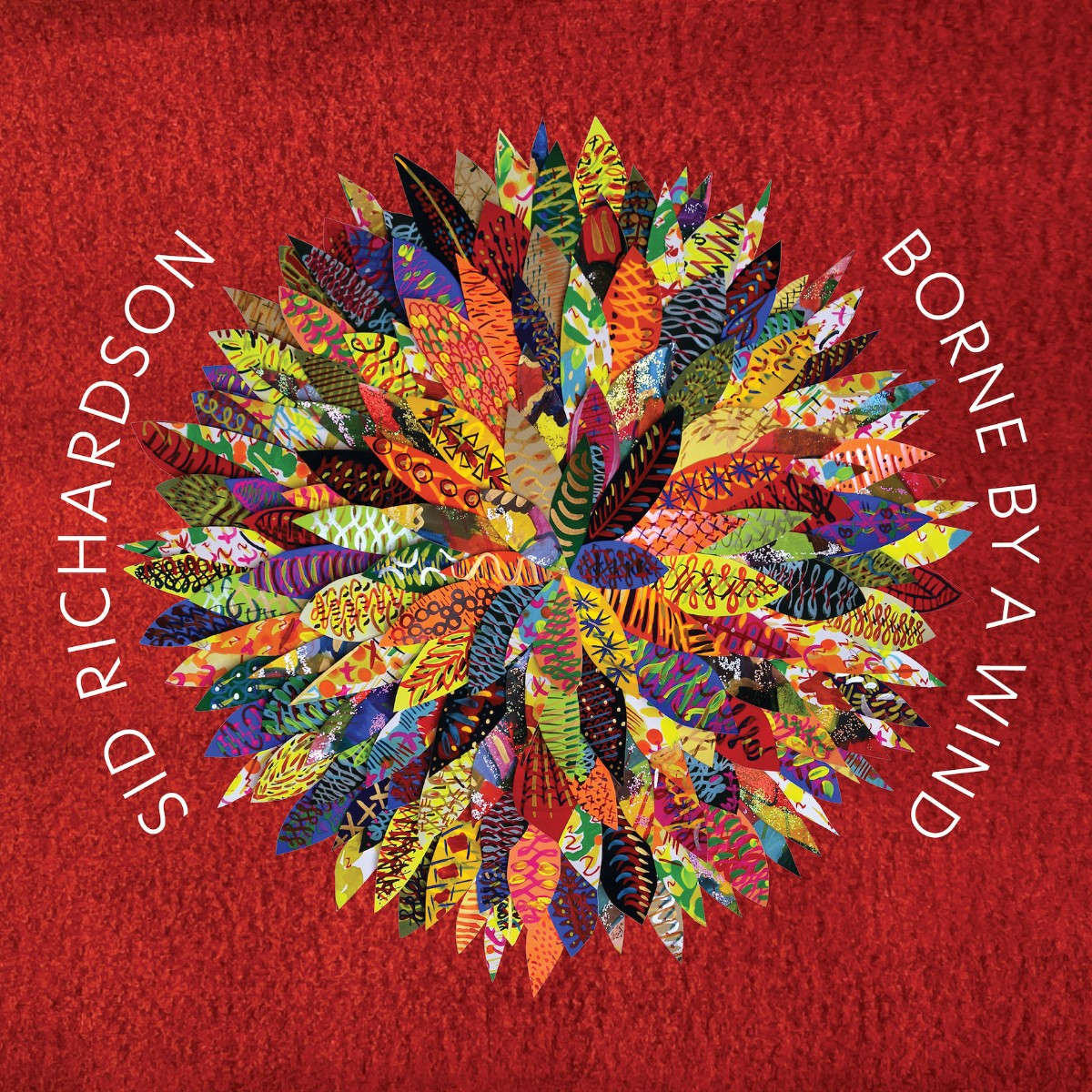
Composer Sid Richardson’s work explores the intersections between music and literature and demonstrates a deft handling of a wide range of compositional and stylistic tools. The featured work on Borne by a Wind, Richardson’s debut album, is a setting of the evocative poetry of National Book Award winner Nathaniel Mackey, and includes the poet reciting his own texts. Earlier works on the recording weave together extra-musical sources of inspiration with a fine blend of harmonic and timbral intricacy that conjures rich emotional states, charting a continuum from mysticism to wit.
The five-movement Red Wind was written for the Deviant Septet, the ensemble in residence at Duke University while Richardson was pursuing his doctoral degree there. The work sets texts from Mackey’s 2015 volume Blue Fasa, and its title refers specifically to one of the poems in the collection, “Hofriyati Head Opening.” The Hofriyati are villagers living in the north of Sudan, and they have a belief in a “red wind” that afflicts possessed persons, who can only be cured through a series of rituals. Indeed, the work as a whole is a sort of tapestry of style, gesture, and rhapsodic texts, spoken and sung. Mackey’s calm baritone voice is contrasted throughout by Mellissa Hughes’ mellifluous soprano.
The opening movement, “A Night in Jaipur,” is a solemn invitation to a ceremony, as ominous pedal points in the bass support the alternation between Mackey’s texts and fluid phrases in voice and muted trumpet. Percussion intermittently asserts a march-like frame. “Head Opening” begins with overlapping spoken texts in narrator and soprano, before pizzicato bass, slithering lines in the winds, and percolating percussion suggest a loose, improvisatory texture. Raw harmonics on the bass and cymbals open “Anabatic Jukebox” before leading into a slow, rolling blues featuring Tim Leopold’s trumpet. Richardson establishes a dichotomy between the vernacular and the experimental in this movement, toggling between the blues, an easy Bossa Nova groove, and disembodied moments of timbral examination.
Hughes leads the beginning of “Anacoluthic Light” with a poignant solo over environmental sounds in the percussion, before her words “light let us down,” provide a segue into Mackey’s recitation and a simmering, mysterious texture. The final movement of Red Wind, “Rag,” again establishes a stylistic duality, this time between murky ensemble colors and a slow ragtime section in the middle. Richardson uses these stylistic intersections as a playwright might arrange scenes — there is a sense of plot and pacing that is enriched by a diverse cast of musical settings.
The solo piano work, There is no sleep so deep, performed here by Conrad Tao, is a musical eulogy for Richardson’s grandmother. Inspired by Samuel Beckett’s play Footfalls, Richardson cultivates contrasting musical spaces in the work, one insistent and obsessive, and the other reflective and philosophical. The multiple layers of activity produced by the accent patterns in the vigorous sections are reminiscent of some of Ligeti and Carter’s virtuoso piano pieces. Meanwhile, sustained bass notes occasionally ring through the fast sections, establishing long-term melodic and structural connections linking the pensive material together.
LUNE, for violin and fixed media, is performed here by Lilit Hartunian, and is inspired by the wails of loons Richardson heard while attending a festival in Vermont. The haunting bird calls in the electronics provide a dialogue partner for mournful lines in the violin. As the work reaches its climax, the pad of sound that provided the environment for the interplay between violin and loon intensifies and briefly threatens to overtake the texture, before receding back into the hazy night.
The final work on the album, Astrolabe, returns to literature and cultural reference as a jumping off point. Richardson captures the mystical wonder that is inherent to the astrolabe, a classical device meant to be a handheld, astronomical model of the universe. Embedding fragments of texts from Chaucer’s Treatise on the Astrolabe and Walt Whitman’s “Kosmos” within musical materials that explore microtonality and spectralism, Richardson creates a ritualistic tone that captures a reverence for the stars.
Sid Richardson’s aesthetic world is expansive and gracious. He embraces components from the avant garde and popular genres alike, and what binds them together is his focus on extra-musical expressive goals. In an era when many artists choose to hyper-specialize as a path towards fine tuning their brand, Richardson chooses instead to take advantage of all the tools at his disposal to articulate a broad, humanistic and outward looking vision through his music.
— Dan Lippel, New Focus Recordings
Selected Press Coverage
AllMusic — Sid Richardson: Borne by a Wind — Review, 2021