We the Way Outward springs from my continued interest in the work of experimentalist poet Nathaniel Mackey, whose poetry and literary criticism engage African American history and culture in a way that emphasizes a cross-cultural approach to art and life. The release of his newest collection of poetry, a three-volume set entitled Double Trio, led me to explore several musical ideas, which have worked themselves into this piece for chamber ensemble.
Its title derives from the protagonists of Mackey’s intertwined poems Song of the Andoumboulou and Mu. They feature a “band of nervous travelers,” who go by many names, and whose peripatetic nature brings them in contact with cultures from around the globe. Norman Finkelstein describes the poet’s penchant for using the nominative, first-person pronoun as his “wandering we.” We, the reader, are participating in the mythos that Mackey unfolds in his poems along with his “philosophic posse”; we’re part of the band searching for gnosis, a point of knowing that comes from without. “We the stubborn consort.” “We the band we were, we the band we’d be.” “We the would-be chorus.” We the Way Outward.
The first movement, Ludic Limp, fixes on musical connotations of limping, off-kilter rhythms juxtaposed with steady pulse streams. In his essay “Sound and Sentiment, Sound and Symbol,” Mackey establishes a connection between limping and empowerment in relation to the African god Legba, one of the gods retained in the New World African traditions of vodoun, candomblé, and lucumí. Legba is often depicted as an old man who walks with a limp because his legs are of unequal lengths, one being rooted in the spirit world and the other in our reality. Nonetheless, he dances. Mackey identifies this joining of “limping disability with the gracefulness of dance” in the music of some of his favorite artists, including John Coltrane, Eric Dolphy, Cecil Taylor, Sun Ra, and Ornette Coleman, among many others. Legba is the god of intersections, doorways, crossroads, thresholds. Mackey relates this interstitial nature to a “forking of the voice,” which he hears in Coltrane’s soloing as he splits his instrument into various registers in dialogue with each other. I’ve applied this idea to the bass clarinet part in Ludic Limp, which constantly jumps between registers in dialogue with itself. While the music in this movement seeks to draw ideas from without, it sometimes resists them. Ultimately all are subsumed and re-contextualized in a playful limping dance.
The second movement, Sonorant Cerement, engages the funereal element in Mackey’s work. The “Song of the Andoumboulou” is a cosmic funeral song the poet encountered on an album of field recordings of the Dogon people of Mali and Burkina Faso. The myth recounted therein deals with Andoumboulous, what Mackey calls “a rough draft of a human being, the work-in-progress we continue to be.” These ancestors have not been properly laid to rest with requisite rites. This story has been the springboard for Mackey’s ongoing mythology, which is spun out in his serial poetry. Peter O’Leary identifies it as “a torn cloth, covering a lost, phantomic body (of knowledge, of lore, of flesh—of a people).” I associate the music and ceremony of Sonorant Cerement with the loss we’ve collectively experienced in the COVID-19 pandemic, which initiated this commission.
The final movement, Goat Gut Gospel, springs from several Mu poems, which evoke a “morning song” as it emerges from the funeral rite of the second movement. “The wail and whine of the goat gut” are envisioned as a cello solo that moves between disjunct musical contexts juxtaposed with one another. Cello and piano come to the fore, following the highlighting of bass clarinet and drums in the first movement, and flute and violin in the second. A prevailing theme of this ensemble is a band made up of distinct characters. It has its roots not only in Mackey’s poems, but also his prose series From a Broken Bottle, Traces of Perfume Still Emanate.
In response to Mackey’s call for “centrifugal work” in his manifesto “Destination Out,” We the Way Outward plays with adding musical influences to his contexts. He suggests that we begin from “whatever [it is that the] medium we find ourselves working in will not do.” This music cannot convey to the audience in a one-to-one relationship the composer’s thoughts and associations, for after all music is an abstract language. We can all, however, bring our own meaning to it; and those ideas could be just as meaningful.
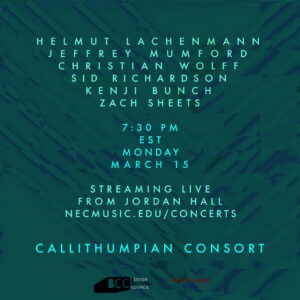
We the Way Outward was commissioned by Boston Musica Viva, Richard Pittman Music Director, as part of the Write It Now Commissioning Initiative. It received its premiere performance on March 13, 2023, in New England Conservatory’s Jordan Hall by the Callithumpian Consort under the musical direction of Stephen Drury.